Most businesses don’t stall because of the market. They stall because they were built around one person. Steve Waugh on the framework that moves an owner-managed business through its ceiling — and turns it into an asset worth selling.
Ask an owner-manager how things are going and you’ll usually hear the same word. “Busy.” Said like it’s a badge of honour.
It rarely is. Busy is the symptom. The diagnosis most owners never get told is the harder one to hear: your business isn’t busy — it’s running through you.
When you’ve built something yourself, you’ve almost certainly built it around yourself. Every decision routes back to you. Every problem lands on your desk. The quotes wait for your sign-off, the team waits for your answer, and the whole thing moves at exactly the speed you can move. That’s your ceiling. And no amount of effort lifts it — because effort is what’s propping it up.
Most owners reach for the obvious fix: hire more people. But more people means more to manage, more admin, thinner margins — and the ceiling doesn’t move. It just gets more expensive to sit under.
Here’s the part worth sitting with. This isn’t a people problem, and it isn’t an effort problem. It’s structural. A self-built business caps at whatever one person can hold. That’s not a flaw in the owner — it’s simply what a business built around one person does. Name the pattern, not the person.
So the real question isn’t “how do I work harder?” It’s “how do I get the business to run without me in the room?” That’s the work. And it has a method.
The Ceiling Analysis
Everything starts with a diagnosis, never a prescription. We call it the Ceiling Analysis. It scores the business across six domains — owner dependency, revenue and growth, people and capacity, process maturity, systems and technology, and compliance and risk — on a simple 1-to-5 maturity scale. The lowest score isn’t a weakness to feel bad about. It’s the binding constraint: the single thing holding everything else back. Fix the constraint and the whole system moves.
Owner dependency carries the most weight, because it’s nearly always the first domino. When a business can’t function without the owner present, every other improvement is built on sand.
“Most owners spend years building the business and about ten minutes planning the way out. We build the exit into the business from the start.”
The LIFT Protocol
Once we know where the ceiling sits, the LIFT Protocol does the moving. LIFT stands for Locate, Install, Free. It maps against roughly 1,540 standard processes that run inside almost any business — the same library of process classifications used to benchmark the best-run companies in the world — and uses that map to find exactly where the load is stuck. Then, domain by domain, we redesign the workflow and install the right machinery to carry it. Sometimes that machinery is automation and AI. Sometimes it’s just better structure. The diagnosis decides — never the other way round.
AI sits at the centre of how we do this — but governed, not bolted on. I hold an ISO 42001 Lead Auditor credential, which means AI gets deployed with the same discipline as anything else we touch. One of the cases I’m proudest of didn’t use any AI at all; it was a structural redesign from start to finish. That’s the point. We prescribe what the business needs, not what’s fashionable to sell.
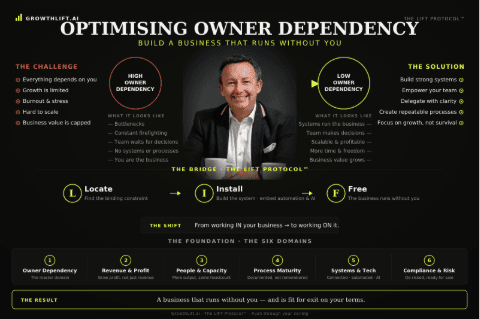
The LIFT Protocol — Locate, Install, Free. The engine that moves a business through its ceiling.
Fix once, benefit twice
When it works, an owner feels six things. The business starts running without them in the room. Revenue grows — and, more importantly, so does profit. The team gets more done without headcount creeping up. The work becomes documented rather than remembered. The systems start talking to each other. And the whole thing becomes less fragile, less dependent on any single person.
Here’s what most owners are never told. Every one of those fixes does a second job. The exact things capping the business today — the dependency, the undocumented process, the key-person risk, the lumpy revenue — are the same things that knock money off the price when you come to sell. A buyer pays a premium for a business that runs without its founder, and a discount for one that doesn’t.
So you fix it once and benefit twice. You operate better now, and you build a runway to a business that’s genuinely fit for exit later. Whether you sell in three years or thirty, you’ve turned a job that owns you into an asset worth something on the day you decide to walk away.
That’s the real shift. From a business that runs through you, to one that runs without you, to one worth selling. Same diagnosis underneath. A far bigger destination on top.
THE METHOD AT A GLANCE
Score → Map → Build → Grow. Measure where the business is across six domains, map the route through, build the fixes one domain at a time, then grow into the headroom they create.
The six owner-outcomes:
It runs without me in the room · More work means more profit, not more chaos · The team does more without the headcount creeping up · It works because it’s documented, not remembered · The systems talk to each other · It wouldn’t stop if I were hit by a bus on Tuesday.
Where’s your ceiling — and what is it costing you?
If any of this sounds like your week, the first step is deliberately small. Steve runs a free fifteen-minute End Goal Review — no pitch, no follow-up sequence. Just one question worth answering honestly. growthlift.ai